Click here to see the animation. Also, this video, links to a 24 hour mapping of flights entering and leaving Hartsfield-Jackson International Airport.
Judge Dredd is not the only fictional prediction of the rise of such mega cities. Other similar ideas are illustrated in a plethora of books, magazines and films that are part of pop culture today. For instance both the films, Blade Runner (1982) and Demolition Man (1993), take place several decades into the future and depict an enormous megalopolis on the west coast stretching from
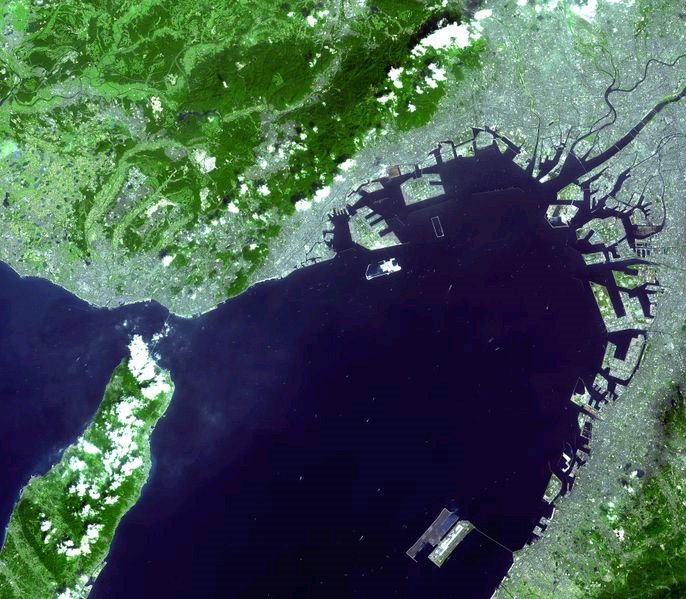
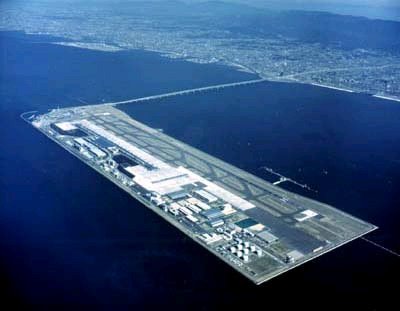
In

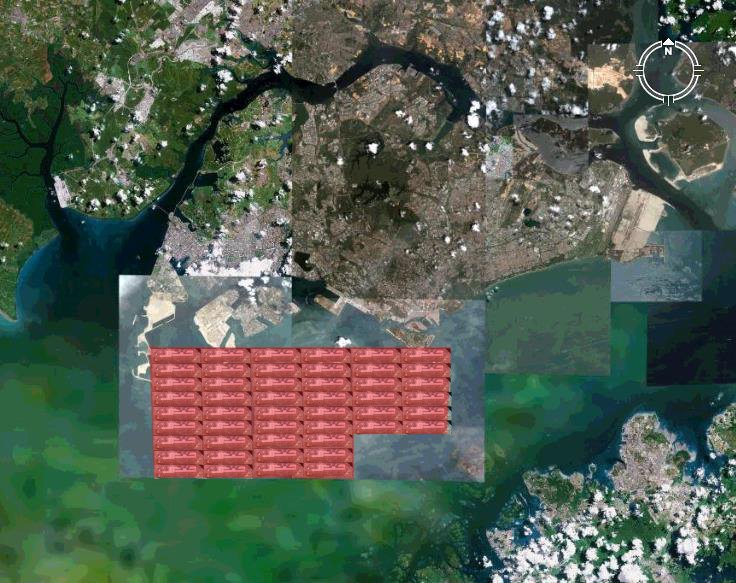
Other similar land forming projects are appearing all around the world such as the island “neighborhoods” near
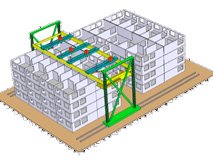 hich he claims will do just that. Khoshnevis is in the process of developing a printer of sorts which can print buildings. He hopes that such machines in the future will be able to build houses, offices, schools and even hospitals. Khoshnevis claims that the first printers will be available for commercial purchase around 2008. These machines use a specially developed concrete mixture to lay down layers of concrete a few inches thick. The Contour Crafter will also be able to install electrical lines and plumbing; the crafter will even be able to do work as specific as printing wallpaper into place. The only thing left to do by manual labor will be installing windows, doors, and other fixtures. Khoshnevis speculates that in twenty years from now the contour crafter will replace most manual labor in the construction industry. The contour crafter is expected to reduce construction costs of a house by about 75% and the construction time to just one day. More detailed information including videos, media reports and a link to the Contour Crafting blog is available at the Contour Crafting website.
  The hope is that the Contour Crafter will be able to solve problems of housing for people suffering from poverty, disaster relief, and just to make homes in general more affordable. Disasters victims such as those after Hurricane Katrina would receive relief housing with plumbing and electricity in a mater of days. Khoshnevis’ website uses the example of a recent earthquake in
 On a different note, what would the Contour Crafter do to high end design? According to Khoshnevis, the Crafter can easily create complex walls, with curves and bends at a fraction of the cost that a conventional construction crew could. He claims that the machine can open the door to more freedom in design. It seems as though this may be true and may even be a goal of Khoshnevis’. However, the people who will most likely purchase these contour crafters will be contractors, not designers. Will architecture turn into just another mundane process? With cookie cutter padio homes so popular today will the construction of building go even farther and bypass the architect all together; customers will simply pick out a plan from a data base and press print?
 In the past few decades, air travel has changed the way the world lives. The world has become a smaller place in that almost any corner of the world is accessible within 24 hours. A statistic posted several days ago on BLDGBlog, states that over the past 30 years, international trade has increased 1,395% and today, 40% of the economic value of all goods is transported via air; not to mention all the passenger travel. Thus in a way, the airplane has become a partial replacement to ocean travel. This post began with some basic research which led to a study done at UCLA in which data was used from the FAA to create a visual mapping of all air traffic over the United States in a 24 hour period. Several short clips analyze different statistics and some very interesting patterns begin to appear; see:
http://users.design.ucla.edu/~akoblin/work/faa/index.html
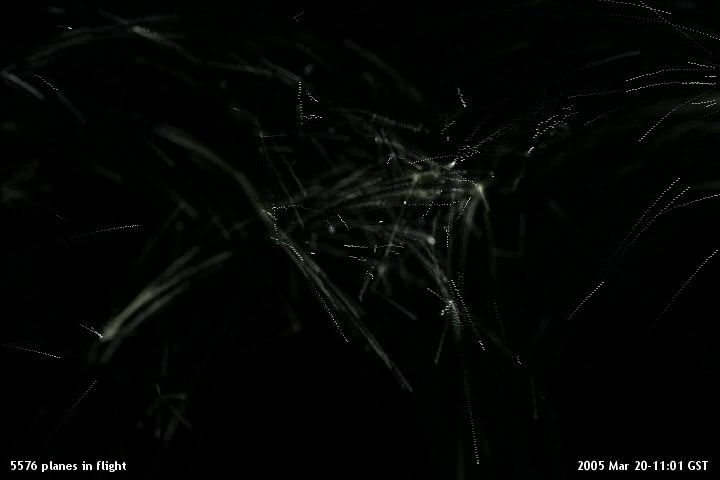 f the most obvious activities is the waking of the country from east to west. One can clearly see how activity in the morning picks up on the east coast and then makes its way to the west. But when one would expect the same to happen in the evening, it never does. Activity across the country begins to fade uniformly. This is one of the most obvious patterns that can be picked out of the short videos, but as one conts to study them, more patterns become to appear.
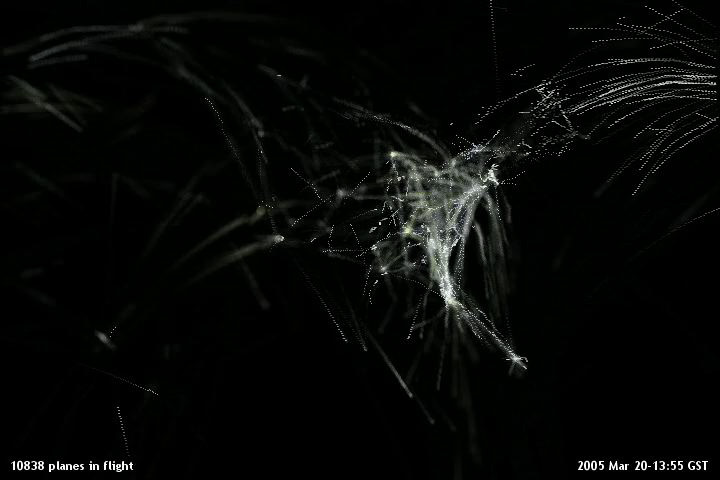 interesting animation in the UCLA collection is the last one titled 3D Bobular. The most abstract animation, in some ways, it also become the clearest animation. the lower three images are frames taken from the 3D Bobular model highlighting some of the most obvious activity in a 24 hour period. Early in the day one can distinctly make out red-eye flights traveling from east to west, then as activity picks up, trans Atlantic flights from Europe create a clear form and towards the end of the day, one can clearly see a wave of trans Atlantic flight leaving the states for Europe.