Wednesday, September 13, 2006

Contour Crafting: A Housing Solution or the Death of Design?

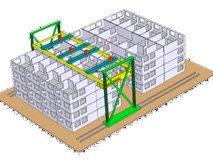
In today’s world, machines have become tools that simplify many processes; cars, clothing, furniture, and countless other goods are manufactured largely by machine rather than manual labor. Robotics have made thousands of goods we buy everyday cheaper, faster, and more convenient, at the same time robotics have put people out of jobs and in many cases diminished product design to a dull and repetitive process. Now, imagine that one could press print and in 24 hours or less, and entire 2000 sqft house would appear. Dr. Behrokh Khoshnevis at the University of Southern California has created what he calls a contour crafting machine which he claims will do just that. Khoshnevis is in the process of developing a printer of sorts which can print buildings. He hopes that such machines in the future will be able to build houses, offices, schools and even hospitals. Khoshnevis claims that the first printers will be available for commercial purchase around 2008. These machines use a specially developed concrete mixture to lay down layers of concrete a few inches thick. The Contour Crafter will also be able to install electrical lines and plumbing; the crafter will even be able to do work as specific as printing wallpaper into place. The only thing left to do by manual labor will be installing windows, doors, and other fixtures. Khoshnevis speculates that in twenty years from now the contour crafter will replace most manual labor in the construction industry. The contour crafter is expected to reduce construction costs of a house by about 75% and the construction time to just one day. More detailed information including videos, media reports and a link to the Contour Crafting blog is available at the Contour Crafting website.

The hope is that the Contour Crafter will be able to solve problems of housing for people suffering from poverty, disaster relief, and just to make homes in general more affordable. Disasters victims such as those after Hurricane Katrina would receive relief housing with plumbing and electricity in a mater of days. Khoshnevis’ website uses the example of a recent earthquake in Bam, Iran (2003); five months after the quake, only 11% of the 75,000 left homeless had shelter. Current portable housing unites are too expensive, time consuming and primitive to alleviate the problem. Conceivably, an entire city could be built in a mater of days for relief victims with homes that are permanent and comfortable. The proposal seems quite amazing, but what effect will such a technology have in the long run? No successful city has ever been built over night, or entirely relocated. If all of the victims receive quality permanent housing, who will want to rebuild what was destroyed? It’s horrible to imagine an ancient city, rich with culture being replaced by an overnight suburban Levittown. Not to say that giving disaster victims speedy and quality should not be done, but would this be the right way?

On a different note, what would the Contour Crafter do to high end design? According to Khoshnevis, the Crafter can easily create complex walls, with curves and bends at a fraction of the cost that a conventional construction crew could. He claims that the machine can open the door to more freedom in design. It seems as though this may be true and may even be a goal of Khoshnevis’. However, the people who will most likely purchase these contour crafters will be contractors, not designers. Will architecture turn into just another mundane process? With cookie cutter padio homes so popular today will the construction of building go even farther and bypass the architect all together; customers will simply pick out a plan from a data base and press print?

September 13, 2006

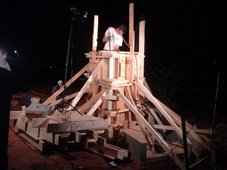
Today felt like a really good day in studio. We took most of the day to finish up our full scale model and materials experiments. For the first time I felt like good progress was made, there was a good energy in the studio and everyone seemed to have positive thoughts of where the communication center is going. I think that the larger models and test really helped us visualize how the project is developing and what changes need to be made. I was surprised at how easy it was to present the models via Skype as well, I had always imagined that it would be much more difficult to present a physical object over the computer screen, but it seems to have worked out fairly well. It's interesting to see the evolution of design and how many earlier ideas keep popping up, I'm interested to see where we end up.

Friday, September 01, 2006

September 1, 2006

Studio today started with a group video conference. It was a bit troublesome simply because of the connection but I feel like a better connection would make all the difference. Sound and picture quality were really good when the connection held up and the system seems like it could be very successful. I feel that the video conference has been the most successful means of communication thus far and feel that it is the easiest form of communication to adapt too.

Global Flight Patterns

In the past few decades, air travel has changed the way the world lives. The world has become a smaller place in that almost any corner of the world is accessible within 24 hours. A statistic posted several days ago on BLDGBlog, states that over the past 30 years, international trade has increased 1,395% and today, 40% of the economic value of all goods is transported via air; not to mention all the passenger travel. Thus in a way, the airplane has become a partial replacement to ocean travel. This post began with some basic research which led to a study done at UCLA in which data was used from the FAA to create a visual mapping of all air traffic over the United States in a 24 hour period. Several short clips analyze different statistics and some very interesting patterns begin to appear; see:

http://users.design.ucla.edu/~akoblin/work/faa/index.html

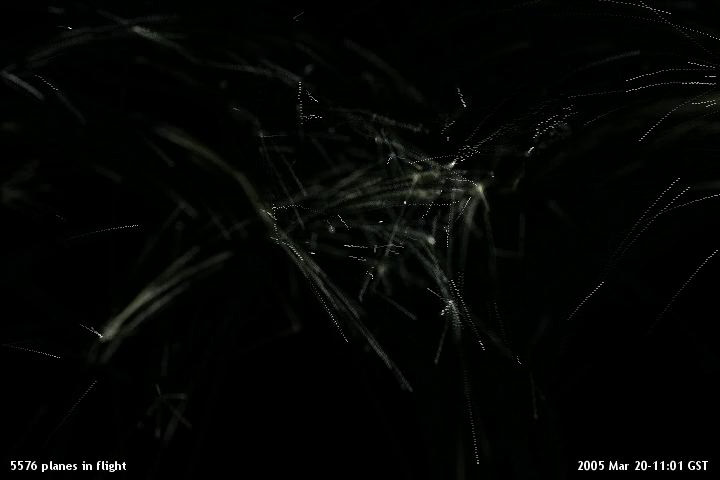
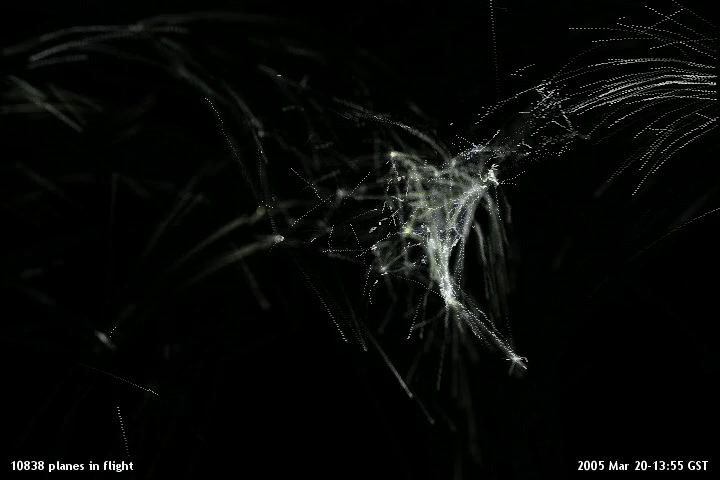
To the right are some frozen frames which begin to illustrate some interesting points. The maps begin at midnight and inclucde several images frozen at different times. One of the most obvious activities is the waking of the country from east to west. One can clearly see how activity in the morning picks up on the east coast and then makes its way to the west. But when one would expect the same to happen in the evening, it never does. Activity across the country begins to fade uniformly. This is one of the most obvious patterns that can be picked out of the short videos, but as one conts to study them, more patterns become to appear.

Perhaps the most interesting animation in the UCLA collection is the last one titled 3D Bobular. The most abstract animation, in some ways, it also become the clearest animation. the lower three images are frames taken from the 3D Bobular model highlighting some of the most obvious activity in a 24 hour period. Early in the day one can distinctly make out red-eye flights traveling from east to west, then as activity picks up, trans Atlantic flights from Europe create a clear form and towards the end of the day, one can clearly see a wave of trans Atlantic flight leaving the states for Europe.

It becomes interesting to see how telling flight patterns are our everyday lives. One could almost make a science out of studying flight patterns in relations to society. One might find that flight patterns could reveal information about daily life or even record changes in society over time. For instance, what would the flight chart above the US have looked like on the evening of September 11, 2001? Now, there is a high correlation of flight activity between economically dominant countries, how will flight patterns reflect a shift in ten years, twenty years, thirty years? What could such a study say about global economy and well being?


Thursday, August 31, 2006

Wednesday's Post Studio Post

Today the studio met for the second time this week. On Monday everyone had a one on one video conference which, for me, was interesting and somewhat frustrating. I was surprised to find that the one on one critique was not as foreign as I had expected via video conference and I felt pretty much right at home in our conversation. The most frustrating part was just the technical difficulties, simply, my computer wasn't able to handle the video feed, but hopefully all those kinks have been worked out, a trip to DCIT and a re imaged C drive should fix the problem for a while.

Today the studio tried a new means of communication. The entire studio entered a group chat to critique and gain insight from each other's posts. This again was a means of communication that I found had advantages and disadvantages. During directed conversation, we had some really interesting and fruitful discussion, the written log is also nice to go back and reference earlier comments; at times I felt like there was really good group conversation. The problems came it when several different ideas were tossed around at the same time, the conversation at times became jumbled and confusing. Also, if your work was being critiqued (or for Ron who was also being bombarded with questions and comments), it was hard to keep up with all the comments and I fear we may be at risk for Carpal Tunnel Syndrome. Overall, I feel that this could become an effective means of studio communication. This form of communication for a studio setting is of course new to all of us and so I think we still need to learn how to use the group chat effectively, like I said, there were times where I felt this was happening. The last thing I feel we need to look out for is verbal conversation amongst ourselves in the studio. Once or twice in the studio, there were conversations that didn't get completely delivered to Ron and this is also and issue which I feel is not a problem if the studio remembers to fill the professor in.

Wednesday, August 30, 2006

Cloud Nine

Among Buckminster Fuller’s more far reaching ideas was his proposal for a Cloud Nine structure. Cloud Nine was a project in which Fuller suggested that large spheres constructed using his geodesic dome structure could float and support living spaces for thousands of people. The geodesic dome is a structure which becomes much stronger as it becomes larger; Fuller along with others feels that a sphere of this construction is quite possible and has calculated that a geodesic sphere, a half mile in diameter, with all of its structure would weigh only one thousandth the amount of the weight of the air trapped inside. A sphere one mile in diameter, with interior air temperature raise only one degree would function as a huge hot air balloon and could support several thousand people. In Fuller’s image shown on the left, he has suggested that such spheres could possibly float between mountains and be tethered to them. While each unit could act independently, Fuller also began to speculate how they could interact with each other and the world below; he suggests the use of photovoltaically powered aircraft (solar powered), an idea taken from Dr. Paul MacReady, as the primary means of transportation between these spheres.

On a larger scale Fuller hoped that Cloud Nine spheres could create communities able to migrate according to changes in environment, population, culture, or any other varying conditions. Another important part of the vision is that Cloud Nine would offer a means for people to “converge and deploy around Earth without its depletion.”

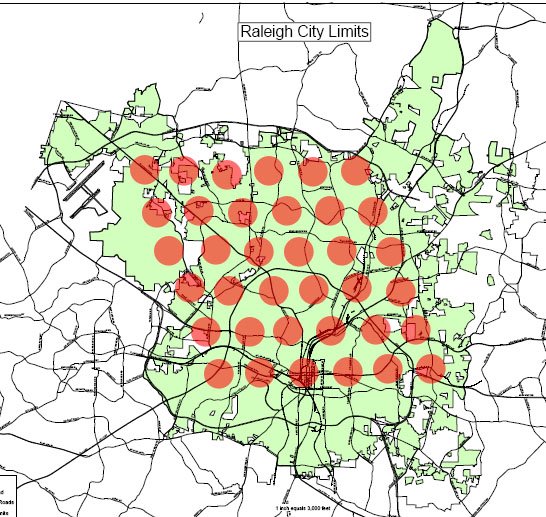
Little follow up has been done on this particular vision of Fuller’s, but it is interesting to speculate on how a Cloud Nine city would function. If we assume that the average Cloud Nine structure supports 7,000 people, it would take between 35 and 36 spheres to create a city of 250,000. A present day city of similar population is Raleigh, NC with a population of about 260,000 (Census 2000).

This first collage explores what a city of 36 Cloud Nine spheres might look like. Since each sphere is also meant to be a self supporting community it is interesting to picture such a city in landscape otherwise unused by humans. As mentioned, Fuller’s idea was that Cloud Nine would allow minimum disturbance to the natural environment below, it becomes interesting to note what a flock of these semi-permanent spheres would do to a landscape, for instance, the Cloud Nine city modeled below would create areas of constant shadow on the desert floor, a condition not natural to this location. Would the sphere cities also have other unperceived impacts on the environment surrounding the community?

Assuming that it would not be preferred for some spheres to occupy space below others, and that a certain spacing would be required between the spheres (for the purposes of allowing sunlight to enter each sphere properly), the map below predicts how the plan layout of a city of 250,000 inhabitants compares to the space covered by a typical city today of that size. The city of Raleigh, NC has been used in this map for means of comparison.

Finally, Buckminster Fuller only briefly mentions that the Cloud Nine spheres could support “several thousand” inhabitants. How would the space of the sphere be divided to allow for communities of this size to inhabit the spaces efficently. The following sketches are my own speculation and experimentation based on some rough statistics.

Sketch to come

Friday, August 25, 2006

Back on Campus

After after leaving Clemson's campus for a year, it feels good to return for what I hope will be my last year. This semester's studio will be an interesting experiment for me and quite the opposite of my off campus experiences last semester. I am excited about participating in one of Clemson's first fluid campus experiments in which the faculty member is off campus and the students are on campus. For me personally, I hope to gain a better understanding of the wide range of tools available for communication today and how these can be integrated into a successful fluid campus system. Many of the programs that will be used to make this class a success are somewhat unfamiliar to me and I look forward to working with my classmates to gain a better understanding of what these tools can offer and how they can change the way I work, design, and communicate. Also, I hope that my efforts along with those of the rest of the studio can set a precedence for future off campus learning possibilities.